
The Surprise Question has been an interesting area of study for some time now. The idea is to ask whether a clinician, “Would you be surprised if this patient died in the next year?” The original intention was to help motivate an advance care planning conversation when the question was answered in the negative (“I would not be surprised…”).
There has also been a good deal of work measuring the operating characteristics (aka, sensitivity and specificity) of these “test” when employed by various types of clinicians unto various types of patients.
A recent such effort was recently published by our friend, colleague, and collaborator, Benzi Kluger (and colleagues), currently available as a “pre-proof” in JPSM for patients with Parkinson’s Disease. (See also a meta-analysis from 2022 in Pall Med)
In their population the mortality rate at one year was ~10% and they measured a sensitivity and specificity of 81% and 59%, respectively…leading to a Positive Predictive Value (PPV) of 18% and Negative Predictive Value (NPV) of 96%.
We will admit that the Yes/No –> PPV/NVP is potentially confusing, just on a linguistic level. So, unless we’re getting it backwards…it seems that if a clinician in the study answered…
- “No, I would not be surprised…” then the likelihood of death in the next year of 18% (relative to 10% for the entire population)
- “Yes, I would be surprised…” then the likelihood of being alive one year later is 96% (relative to 90% for the entire population)
So, how useful is this test. Well, before we ask the clinician anything, we know that the risk of death in the next year (in this population) is 10%.
- The answer of “No” (not surprised) increases a patient’s apparent risk to 18%, up 8 percentage points.
- The answer of “Yes” (surprised) decreases a patients apparent risk to 4%, down 6 percentage points.
We might also be interested in how the Surprise Question (SQ) in PD fares relative to other diseases. The meta-analysis linked above (and here) provides very nice graphs to help us visualize the SQ’s aggregate performance in a variety of disease types…
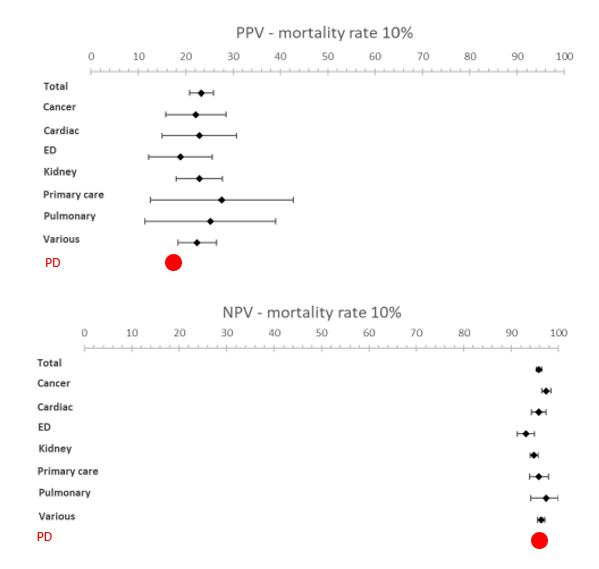
We’d say the performance in PD is pretty close to in line with other contexts. Thank you Benzi et al!
 act-ur.com